No-code vs Custom development : 2026 guide

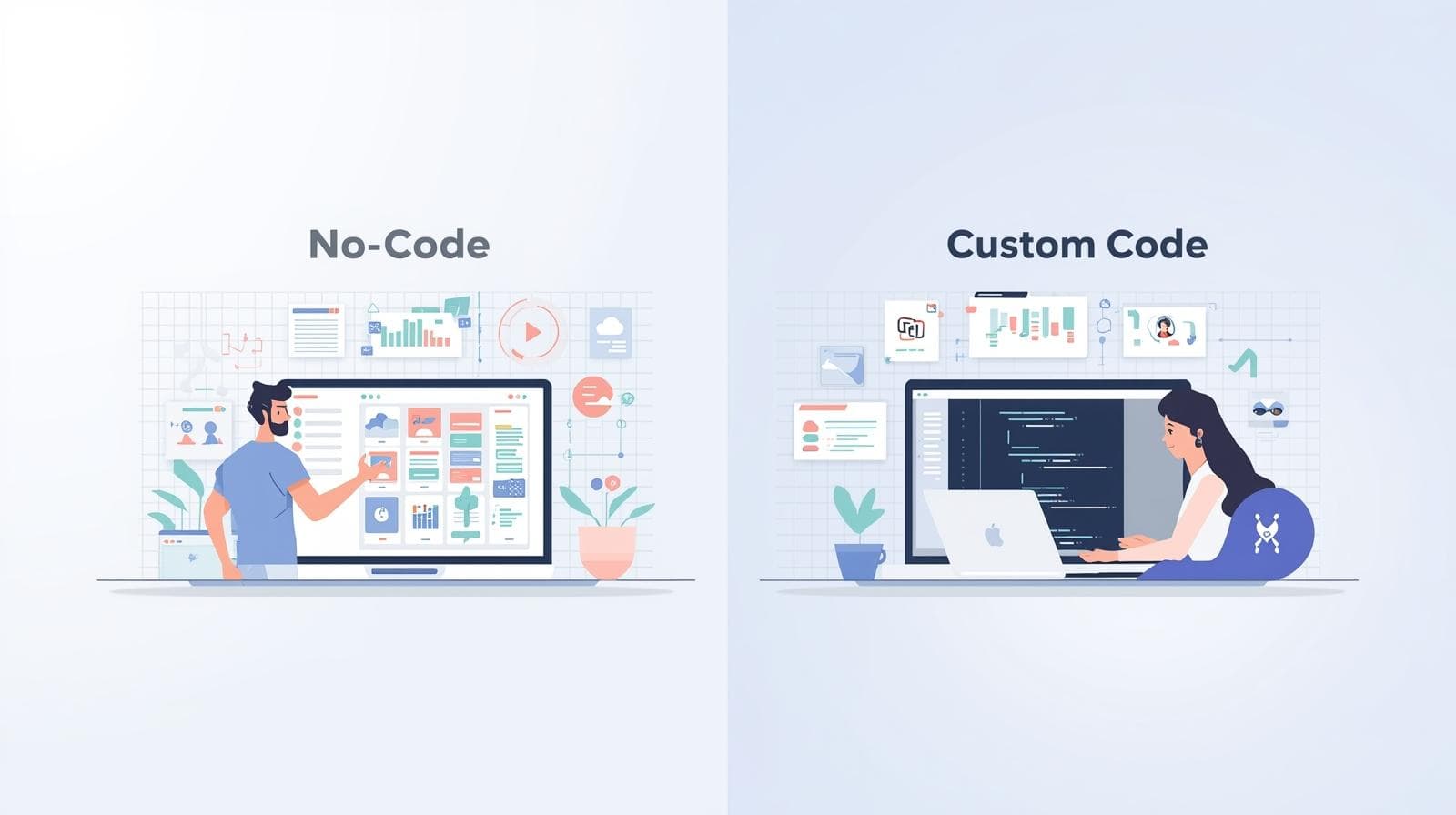
Every founder hits this wall. You've validated the idea, talked to potential customers, maybe even collected some emails. Now you need to actually build the thing. And suddenly you're drowning in conflicting advice about whether to use Bubble or hire developers.
Which Is Better?
Stop asking this question. Question itself is wrong. There's no universal "better choice." But there is a right choice for your specific situation, The right question is: "what does your product actually need right now, and what will it need in 12 months?"
A marketplace connecting local service providers? No-code handles that beautifully. A payments heavy SaaS handling subscriptions, PCI compliance, and complex billing logic? You need code from day one. An AI-powered SaaS analytics dashboard? Probably somewhere in between.
The founders who waste time and money are the ones who pick based on vibes rather than requirements. Now you shouldn't be in that category.
Understanding Your Options
Path 1: No-Code Development
Platforms like Bubble, Webflow, and Adalo let you build functional applications through visual interfaces. Drag components, connect logic flows, launch without writing code.
Best for: Validating unproven ideas, non-technical solo founders, tight runways, products where speed matters more than customization.
We break this down completely in our guide on when no-code makes sense for your MVP.
Path 2: Custom Development
Traditional development with programming languages, frameworks, and databases. Engineers writing React.js, Next.js, Supabase, Postgress, Node.js building exactly what you specify.
Best for: Regulated industries, complex integrations, proprietary technology, enterprise customers, performance-critical applications.
Our detailed breakdown on when custom development makes sense covers the costs, timelines, and decision criteria.
No-code vs Custom development
| Factor | No-Code Development | Custom Development |
|---|---|---|
| Basic MVP Cost | $0–$5,000 | $10,000–$50,000+ |
| Monthly Ongoing Cost | $50–$500+ (platform fees) | $500–$2,000 (hosting/maintenance) |
| Time to MVP | 2–6 weeks | 2–6 months |
| Technical Skills Required | almost None (learning curve: 2–4 weeks) | Professional developers needed |
| Customization | Limited to platform capabilities | build anything |
| Scalability Ceiling | 10,000–50,000 users typically | No inherent limits |
| Code Ownership | No locked to platform | you own everything |
| Performance Control | Limited optimization options | Full stack optimization |
| Security & Compliance | Platform-dependent; limited certifications | SOC 2, HIPAA, PCI DSS achievable |
| Third-Party Integrations | Pre-built connectors only | Any API, any system |
| Maintenance Burden | Platform handles infrastructure | Your team handles everything |
| Iteration Speed | Very fast (hours/days) | Slower (days/weeks) |
| Best For | Validation, MVPs, internal tools, marketplaces | Regulated industries, enterprise, proprietary tech |
| Worst For | Complex algorithms, compliance-heavy, performance-critical | Unvalidated ideas & tight budgets |
If your budget and timeline are tight and you want quality development too, custom development isn't on the table unless it's innew.
Real Examples, Real Companies, Real Decisions
Abstract frameworks only go so far. How actual startups made this choice:
Calendly: Outsourced Custom MVP
Founder Tope Awotona invested $200,000+ of personal savings (401k, credit cards, business loans) to outsource MVP development to Ukrainian firm Railsware.That custom-coded foundation took the company from $550K seed funding to $60M ARR a capital efficiency that wouldn't have been possible rebuilding from a no-code MVP later.
Airbnb: Started Custom, Stayed Custom
The founders built the most basic custom website imaginable is photos of their apartment, a simple booking form, air mattresses as the product. No user accounts, no payment processing, no reviews.That minimal custom foundation scaled to 7+ million listings and a $75 billion valuation. They owned the code, so they could evolve it. Full story in our custom development guide.
Makerpad : Built Entirely on No-Code
Makerpad started as a subscription-based SaaS learning platform built using Webflow, Airtable, Zapier, and Memberstack. There was no traditional backend in the early days just workflows, gated content, and payments.It reached strong recurring revenue and was later acquired by Zapier.
No-code to custom : When to Switch Paths
Sometimes the right answer is: start with one approach, transition to another.
Signs You've Outgrown No-Code
- Database operations timing out regularly
- Page loads exceeding 3-4 seconds
- Platform costs approaching $500-1,000/month
- Workarounds consuming 20+ hours monthly
- Investors asking for code ownership
- Enterprise customers requiring compliance certifications you can't achieve
If you're seeing these signals, it's time to plan a transition,smart chooice, not panic-migrate when things break.
The Migration Reality
Moving from no-code to custom isn't a "migration", it's a rebuild. You can't export no-code platform logic to code. Your no-code version becomes a detailed specification for what your custom version needs to do.
Budget accordingly. Companies report spending $50,000-$150,000 to rebuild no-code applications in custom code, depending on complexity.
The silver lining: you'll know exactly what to build because you've already built it once and learned what users actually need.
Your Decision Checklist
Answer below questions honestly, and you’ll have a clear decision for sure.
Choose no-code if:
- You're testing an unproven concept
- Budget is under $10,000
- Timeline is under 6 weeks
- Your competitive advantage isn't technical
- You're building marketplaces, portals, directories, or content platforms
- You can accept platform dependency
Choose custom development if:
- Technology IS your competitive moat
- You're in fintech, healthcare, or enterprise B2B
- Performance requirements are non-negotiable
- You have validated demand and $50K+ budget
- Investors or acquirers will evaluate your codebase
- Complex integrations define your core workflow
Three Critical Questions:
1. Is technology your competitive advantage? If differentiation comes from proprietary algorithms or unique data processing, custom code is your only option. If you're winning on customer experience or distribution, no-code handles it.Linear built custom local-first architecture because speed wasn't just a feature. It was their entire value proposition against Jira. That required owning the code.
2. What industry are you building for? Fintech/healthcare almost always need custom code. Enterprise B2B needs SSO, audit logs, and security questionnaires. Consumer apps and marketplaces? No-code sweet spot. Platforms like Bubble have proven these categories work at scale.
3. How certain is your product direction? Still testing who your customer is or whether people will pay? Spending $15K-$150K on custom development is premature optimization. Have validated demand with paying customers or signed LOIs? Invest in proper architecture bcoz you're building for confirmed growth, not guessing.
Conclusion
Match your approach to your actual constraints : time, money, technical requirements, and competitive positioning. No-code isn't cheating. Custom code isn't overkill. they are not magic. They're tools. Pick the one that fits your situation right now, and plan for what you'll need next.